The hardest part of sleep is sometimes not getting into bed.
It is getting there mentally.
You finish the day, close the laptop, answer one last message, check one more notification, and suddenly your body is in bed while your attention is still somewhere else.
A wind-down ritual creates a small transition between the two.
It does not need to be complicated. It does not need to take an hour. And it does not need to work perfectly every night.
The idea is simply to repeat a few calming cues in roughly the same order: lower the stimulation, put some distance between yourself and your phone, slow your breathing, and give your attention something quiet to settle on.
Research supports several parts of this approach. Evening light exposure can influence circadian timing and sleep-related processes. Screen use around bedtime is consistently associated with poorer sleep outcomes. Recent research also suggests that slow breathing before bed may improve self-reported sleep quality and sleep duration, although evidence from objective sleep measurements remains less certain. And music listening has been associated with improved subjective sleep quality in adults with sleep difficulties.
The goal, then, is not to force yourself to fall asleep. It is to make the transition toward sleep easier.
Why a wind-down ritual helps
Sleep is not simply an on and off switch.
Your body moves through changing levels of alertness throughout the evening. Light, activity, stimulation, thoughts and habits can all become part of that transition.
A repeated wind-down routine gives your brain a predictable sequence that signals: the day is ending.
This does not mean that a ritual can override every cause of poor sleep. Stress, illness, medication, shift work, sleep disorders and many other factors can affect sleep. But a simple routine can remove some of the unnecessary stimulation surrounding bedtime.
The key is repetition. You are not trying to perform the perfect sleep routine. You are building a familiar path toward rest.
1. Lower the light
About ten minutes before you want to begin your wind-down, start reducing unnecessary brightness.
Turn off strong overhead lighting if you can. Use a softer lamp. Lower the brightness of screens if you still need to use one.
The reason is not that warm lighting is magically sleep-inducing. Light is one of the strongest environmental signals influencing the circadian system. Evening exposure to light, particularly short-wavelength light, can affect circadian timing and sleep-related outcomes.6
A systematic review examining interventions designed to reduce short-wavelength light exposure before sleep found evidence suggesting that reducing this exposure can help limit some adverse effects on sleep, although results vary between interventions and studies.7
So think of dimming the room as a signal, not a treatment. You are making the environment quieter for your biological clock.
2. Create distance from your phone
The phone does not have to disappear forever. It just needs to stop demanding your attention.
Put it on a table instead of beside your pillow. Turn on Do Not Disturb. Silence non-essential notifications. If you use your phone for your final meditation or sound session, choose the session first, start it, and then put the phone away.
The goal is to remove the reflex of checking.
Research consistently finds an association between electronic media use and poorer sleep outcomes. A recent systematic review and meta-analysis involving more than 548,000 participants found that greater screen exposure was associated with shorter sleep duration, delayed bedtime and greater risk of insomnia symptoms.2
These studies cannot prove that every minute of screen use directly causes poor sleep. But they reinforce a practical idea: the less stimulating your final moments before bed become, the easier it may be to create a genuine transition into sleep.3
3. Slow your breathing
Now give your body five minutes of something simple. Slow the breath.
You do not need to force a particular pattern. You do not need to take extremely deep breaths. Try breathing comfortably at a slower pace than usual.
For example: inhale gently for about four seconds, exhale slowly for about six seconds, then repeat. If that feels uncomfortable, make the breaths smaller and the pace easier. The goal is comfort, not maximum breath volume.
This part of the ritual has particularly interesting recent evidence. A 2026 systematic review examined nine studies involving 457 participants who practiced slow breathing before bedtime. The review found improvements in self-reported sleep duration and sleep quality in several studies. However, findings from objective measures such as actigraphy and polysomnography were inconclusive.1
That distinction matters. Slow breathing appears promising as a pre-sleep relaxation practice, but it should not be presented as a guaranteed treatment for insomnia. Think of it as a way to reduce stimulation and give your attention something steady to follow.
4. Let sound become the final anchor
Once the room is dim and your phone is no longer asking for attention, introduce one final element: sound.
Choose something slow and unobtrusive. Rain. Gentle waves. Soft ambient sound. A singing bowl. A quiet meditation. Or another sound that you personally associate with slowing down.
The purpose is not to find a magical frequency. The purpose is to create a stable auditory environment that does not demand active attention.
Music has a more substantial research base than many specific sleep frequency claims. A Cochrane review of adults with insomnia symptoms found moderate certainty evidence that listening to music can improve subjective sleep quality, although evidence for objective sleep measures was much less certain.4 Another systematic review and network meta-analysis found that music interventions were associated with improvements in sleep quality and some sleep-onset measures in adults with primary insomnia.5
So sound can be part of the ritual. Just keep the claim realistic. It may help you settle. It does not guarantee sleep.
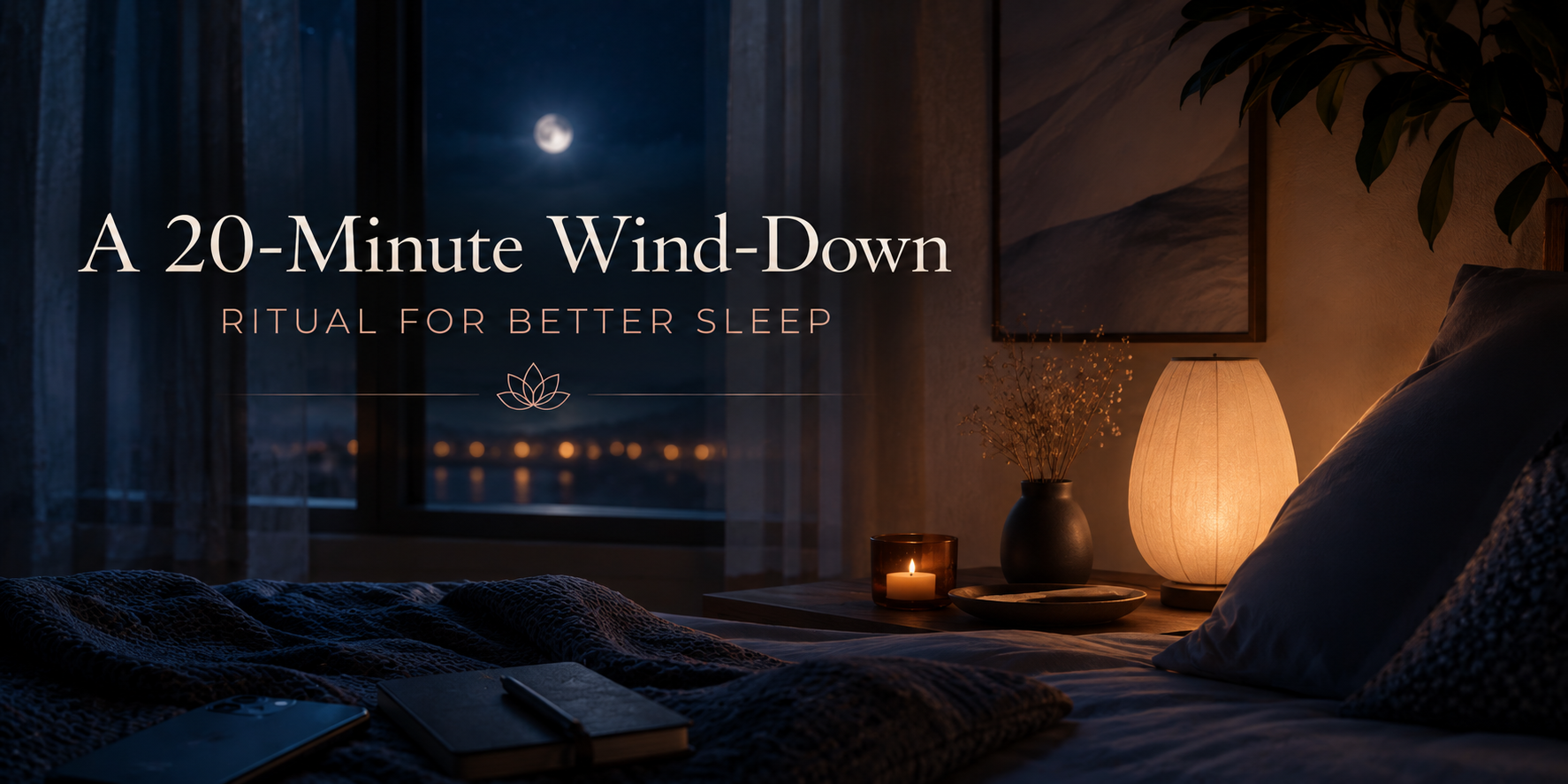
A simple 20-minute Imuzar ritual
Now put the four pieces together. You do not need to follow the clock perfectly. Use the twenty minutes as a simple framework.
Minutes 0 to 5. Lower the stimulation. Dim the room. Finish anything essential. Put the phone out of reach. Let the environment become quieter.
Minutes 5 to 10. Sit or lie comfortably. Begin slow, comfortable breathing. Try a gentle four-second inhale followed by a six-second exhale. If counting becomes distracting, stop counting and simply slow the breath.
Minutes 10 to 20. Choose an Imuzar meditation or calming sound. Let it play without constantly changing tracks. Listen. Notice your breathing. Notice the sensations in your body. When thoughts about tomorrow appear, do not fight them. Return to the sound.
When the session ends, allow a little silence before turning the light off. The ritual is complete. You do not need to measure whether it worked. Simply go to bed.
Your Imuzar wind-down
Dim the room. Put the phone away. Slow your breathing. Choose one quiet sound or meditation. Then stop doing. For the next few minutes, there is nowhere else to be.
What if you only have five minutes?
Do not abandon the ritual because you cannot do all twenty minutes. Use five.
Dim the light. Put the phone away. Take a few minutes of slow, comfortable breaths. Then lie down.
A routine does not become useful because it is long. It becomes useful because you can actually repeat it.
The twenty-minute version is simply a framework. Your real routine may eventually become ten minutes, or five, or thirty. The most important part is creating a predictable transition that you can maintain.
Key takeaways
- A good wind-down routine does not need to be complicated.
- Reducing evening light can help create an environment that is more compatible with the body's circadian signals.
- Putting the phone away reduces opportunities for continued stimulation and is consistent with evidence linking bedtime screen exposure with poorer sleep outcomes.
- Slow breathing before bed shows promising effects on self-reported sleep quality, although objective sleep findings remain less certain.
- Music and calming sound may improve subjective sleep quality for some adults, but sound should not be presented as a guaranteed sleep treatment.
- The goal is not to force sleep. The goal is to create the conditions in which sleep can happen more naturally.
Dim the room. Slow down. Listen. Let the day end.
References
Imuzar articles are based on peer-reviewed scientific research and trusted academic sources whenever applicable.
- Eide EM, Hernes HM, Grønli J. Slow breathing techniques before bedtime and the effects on sleep: A systematic review. Sleep Medicine Reviews (2026). https://pubmed.ncbi.nlm.nih.gov/41886931/
- He X, Pan B, Ma N, et al. The association of screen time and the risk of sleep outcomes: A systematic review and meta-analysis. https://pubmed.ncbi.nlm.nih.gov/41480345/
- Han X, Zhou E, Liu D. Electronic Media Use and Sleep Quality: Updated Systematic Review and Meta-Analysis. https://pubmed.ncbi.nlm.nih.gov/38533835/
- Jespersen KV, Pando-Naude V, Koenig J, Jennum P, Vuust P. Listening to music for insomnia in adults. Cochrane Database of Systematic Reviews (2022). https://pubmed.ncbi.nlm.nih.gov/36000763/
- Feng F, Zhang Y, Hou J, et al. Can music improve sleep quality in adults with primary insomnia? A systematic review and network meta-analysis. International Journal of Nursing Studies (2018). https://pubmed.ncbi.nlm.nih.gov/29100201/
- Cyr M, Artenie DZ, Al Bikaii A, Borsook D, Olson JA. The effect of evening light on circadian-related outcomes: A systematic review. Sleep Medicine Reviews (2022). https://pubmed.ncbi.nlm.nih.gov/35753149/
- Interventions to reduce short-wavelength (blue) light exposure at night and their effects on sleep: A systematic review and meta-analysis. Sleep Advances. https://pubmed.ncbi.nlm.nih.gov/37192881/
Frequently asked questions
Do I really need twenty minutes?
No. Twenty minutes is simply a practical framework.
You can use five or ten minutes if that is what fits your evening. There is no evidence that exactly twenty minutes is required for better sleep.
Should I stop using my phone completely before bed?
Not necessarily.
If you use your phone to start a meditation or calming sound, prepare the session and then put the phone away. The goal is to reduce unnecessary stimulation and repeated checking, not to create an unrealistic rule.
Does slow breathing help you fall asleep?
Recent research suggests that slow breathing before bedtime may improve self-reported sleep quality and sleep duration.
However, evidence from objective sleep measurements is still inconclusive. It is best viewed as a relaxation practice rather than a guaranteed sleep treatment.
Is four seconds in and six seconds out the best breathing pattern for sleep?
There is no single breathing pattern proven to be best for everyone.
A four-second inhale and six-second exhale is simply an accessible example of slower breathing. If counting feels uncomfortable, use a gentler rhythm.
Can ambient sounds help me sleep?
They may help some people. Music has moderate evidence for improving subjective sleep quality in adults with insomnia symptoms.
Evidence for continuous noise as a sleep aid is more mixed, so choose a sound that feels calming rather than assuming that any background noise will improve sleep.
Should I leave the sound playing all night?
Not necessarily. There is no established requirement to play a sound continuously throughout the night. A short session can be enough to become part of your wind-down routine.
If you prefer continuous sound, keep the volume low and choose a stable, unobtrusive recording.
Can I use Imuzar while falling asleep?
Yes. Imuzar can be used as part of a quiet evening ritual.
Choose a meditation, nature sound or calming audio that you personally find relaxing, keep the volume comfortable, and allow the session to become part of your transition toward sleep.
What if I still cannot sleep after the ritual?
Do not turn the ritual into another thing you have to succeed at.
If sleep difficulties are persistent, severe or affecting your daytime functioning, consider discussing them with a healthcare professional. A wind-down routine can support healthy sleep habits, but it is not a substitute for evaluation or treatment of a sleep disorder.