An anxious moment can make everything feel faster.
Your thoughts accelerate. Your shoulders tighten. Your breathing may become quicker or shallower. In that moment, deliberately changing the way you breathe can give you something simple and concrete to focus on.
Box breathing is one of the easiest patterns to remember.
You inhale for four counts, pause for four, exhale for four, then pause for four before beginning again.
The pattern is simple enough to remember without an app, timer or special equipment.
And while research does not establish box breathing as a cure for anxiety, a broader body of research suggests that controlled and slower breathing practices can help reduce stress and anxiety for many people.
That makes box breathing worth exploring as a small, practical tool for moments when you want to slow things down.
Why controlled breathing can feel calming
Breathing is unusual because it happens automatically, but you can also change it deliberately.
That makes it a useful bridge between attention and the body.
When you intentionally slow your breathing, several physiological systems respond. Research on slow breathing has found changes in cardiovascular and autonomic activity, including heart rate variability and respiratory sinus arrhythmia. Studies also associate slow breathing with feelings such as relaxation and reduced physiological arousal.2
A systematic review of slow-breathing research found evidence of changes involving the autonomic nervous system, cardiovascular regulation and psychological states. The authors also reported associations with reduced arousal, anxiety and other negative emotional states.2
A larger systematic review of breathing interventions published in 2024 examined 19 studies involving adults and found that 12 reported significant improvements in anxiety and nine reported significant improvements in stress. The authors also noted that larger randomized controlled trials are still needed.1
This distinction matters.
The evidence supports controlled breathing as a promising tool for stress and anxiety management.
It does not mean that every breathing pattern will work equally well for every person.
Why the 4-4-4-4 pattern is easy to follow
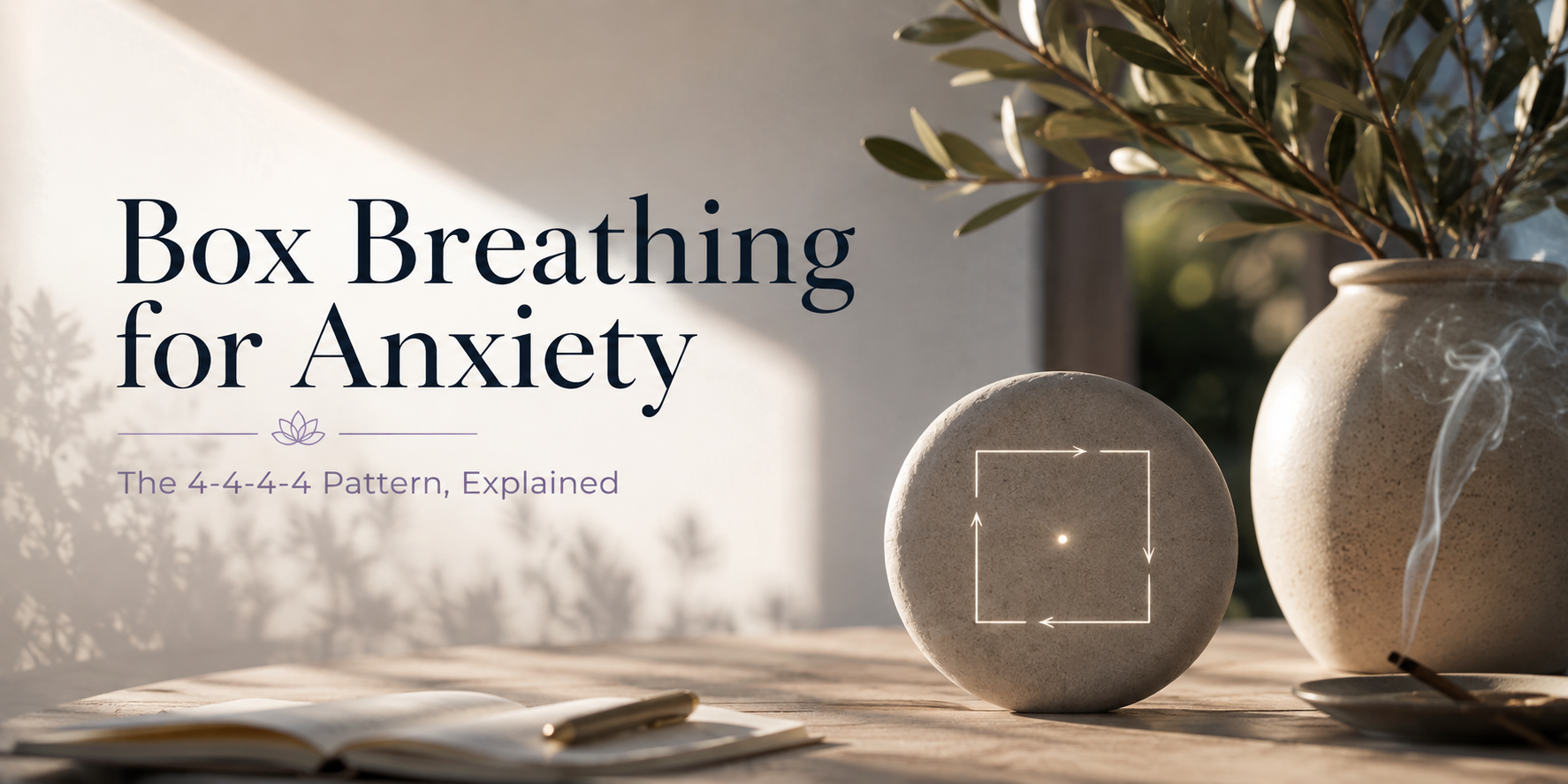
Box breathing divides one breath into four equal parts: inhale, pause, exhale, pause. Each phase lasts four counts.
The symmetry is part of what makes the pattern easy to remember. Instead of trying to control your breathing randomly, you have a simple structure to follow.
You can think of it as a square: four seconds in, four seconds pause, four seconds out, four seconds pause. Then repeat.
The number four is not a scientifically established magic number.
If four seconds feels comfortable, it gives you a useful starting point. If it feels too long, shortening the count is perfectly reasonable.
The goal is not to win a breath-holding competition.
The goal is to create a slow, comfortable rhythm that you can sustain without strain.
A three-minute box breathing practice
Find a comfortable position.
You can sit in a chair, sit on a cushion or simply stand with your shoulders relaxed.
Let your breathing settle naturally for a few moments before beginning. Then try the following:
- Inhale gently for 4 seconds.
- Pause for 4 seconds.
- Exhale slowly for 4 seconds.
- Pause for 4 seconds.
- Repeat.
Twelve rounds will take a little over three minutes.
Keep the breathing gentle. There is no need to take a huge breath. There is no need to force the pauses. There is no need to empty your lungs completely.
The experience should feel controlled and comfortable.
If four seconds feels too long
Try 3-3-3-3 instead. A shorter pattern that feels natural is more useful than a longer pattern that makes you tense.
Making the practice comfortable
The most important part of a breathing exercise is not perfect counting. It is comfort.
Try to avoid turning the exercise into a performance.
Your shoulders can remain relaxed. Your jaw can remain soft. Your breath can remain quiet. And your attention can stay on the rhythm rather than on whether you are doing everything perfectly.
If you become uncomfortable during a pause, simply shorten it or return to normal breathing.
Some people find breath-holding uncomfortable, especially when they are already anxious. There is no benefit in forcing it.
Box breathing should be a gentle practice, not a test of endurance.
When to use box breathing
You can experiment with box breathing whenever you want a short pause in the middle of the day.
- Before an important conversation.
- Before a presentation.
- After a stressful email.
- During a busy workday.
- Before meditation.
- When transitioning from work into your evening.
Or simply when you notice that your breathing has become quick and your attention feels scattered.
You do not have to wait until you feel extremely anxious.
It can also become a small daily ritual. Three minutes of deliberate breathing can create a clear transition between one activity and the next.
What the research says
Research on breathing exercises is encouraging, but it is important to distinguish between evidence for controlled breathing generally and evidence for the specific 4-4-4-4 box breathing pattern.
A 2024 systematic review examined 19 studies of breathing exercises in adults and found improvements in anxiety in 12 studies and improvements in stress in nine. The authors concluded that breathing exercises can be useful for reducing anxiety and stress, while also noting that evidence from large randomized controlled trials remains limited.1
A separate systematic review of slow breathing examined 15 eligible studies and found effects involving autonomic and central nervous system activity, as well as psychological outcomes such as relaxation and reduced anxiety-related arousal.2
A 2022 systematic review and meta-analysis also examined voluntary slow breathing and its effects on heart rate variability, an important measure of cardiac autonomic regulation.3
Research therefore gives us a reasonable basis for exploring controlled breathing as a relaxation and stress-management practice.
But it does not establish that 4-4-4-4 is universally superior to every other breathing pattern.
That is why Imuzar approaches box breathing as a practical invitation: try it, notice how it feels, keep it gentle, and discover whether it becomes useful for you.
Try it with Imuzar
Your practice does not need to begin with a long session. Find a quiet minute, settle into a comfortable position, and let the 4-4-4-4 rhythm carry your attention away from the noise of the day. Pause. Breathe. Slow down. Return to the present.
Explore guided breathwork in Imuzar and build your own ritual.
Key takeaways
- Box breathing uses four equal phases: inhale, pause, exhale and pause.
- The familiar 4-4-4-4 pattern is simple to remember and can be practiced almost anywhere.
- Research on controlled and slow breathing suggests potential benefits for stress, anxiety and physiological regulation.
- The scientific evidence is stronger for controlled breathing as a broader practice than for the specific 4-4-4-4 pattern.
- Four seconds is a starting point, not a requirement.
- If the pauses feel uncomfortable, shorten them or return to natural breathing.
- The goal is calm, comfortable breathing, not perfect performance.
- A few minutes of consistent practice may be easier to maintain than an elaborate routine.
References
Imuzar articles are based on peer-reviewed scientific research and trusted academic sources whenever applicable.
- A Systematic Review of Breathing Exercise Interventions: An Integrative Complementary Approach for Anxiety and Stress in Adult Populations. Journal of Holistic Nursing (2024). https://pubmed.ncbi.nlm.nih.gov/39150318/
- Zaccaro A, Piarulli A, Laurino M, et al. How Breath-Control Can Change Your Life: A Systematic Review on Psycho-Physiological Correlates of Slow Breathing. Frontiers in Human Neuroscience (2018). https://pubmed.ncbi.nlm.nih.gov/30245619/
- Laborde S, Allen MS, Borges U, et al. Effects of voluntary slow breathing on heart rate and heart rate variability: A systematic review and a meta-analysis. Neuroscience & Biobehavioral Reviews (2022). https://pubmed.ncbi.nlm.nih.gov/35623448/
- Fincham GW, Strauss C, Montero-Marin J, Cavanagh K. Effect of breathwork on stress and mental health: A meta-analysis of randomised-controlled trials. Scientific Reports (2023). https://pmc.ncbi.nlm.nih.gov/articles/PMC9828383/
- Balban MY, Neri E, Kogon MM, et al. Brief structured respiration practices enhance mood and reduce physiological arousal. Cell Reports Medicine (2023). https://doi.org/10.1016/j.xcrm.2022.100895
Frequently asked questions
Can box breathing help with anxiety?
Controlled breathing may help reduce stress and anxiety for some people. Research supports breathing exercises as a promising tool for anxiety and stress management, although results vary and evidence for brief techniques is still developing.
Box breathing should be considered a self-regulation practice, not a replacement for professional treatment.
How long should I do box breathing?
Start with around three minutes.
If the practice feels comfortable, you can continue for longer. There is no need to force a specific duration.
What if four seconds feels too long?
Shorten the count. Try 3-3-3-3 or another comfortable, even rhythm.
The objective is to create a steady and comfortable breathing pattern rather than to maintain a specific number.
Should I breathe through my nose or mouth?
Use whichever feels comfortable and natural.
A gentle nasal inhale may feel comfortable for many people, but there is no need to force nasal breathing if it feels difficult. The priority is relaxed, comfortable breathing.
Can box breathing stop a panic attack?
It may help some people reduce physiological arousal and regain a sense of control, but it is not a guaranteed way to stop a panic attack.
If panic attacks are frequent, severe or interfering with daily life, professional medical or mental-health support is appropriate.
Is box breathing safe for everyone?
Breathing exercises are generally well tolerated, but breath-holding may be uncomfortable for some people.
If you have a respiratory, cardiovascular or other medical condition, or if breath-holding causes dizziness, chest discomfort or significant distress, stop the exercise and seek appropriate medical advice. Never force your breathing.
Can I practice box breathing before meditation?
Yes. A few minutes of controlled breathing can serve as a transition into meditation by giving your attention a simple rhythm to follow.
After the breathing exercise, allow your breathing to return to its natural rhythm before beginning your meditation.