There are sounds we hear, and there are sounds we choose to spend time with.
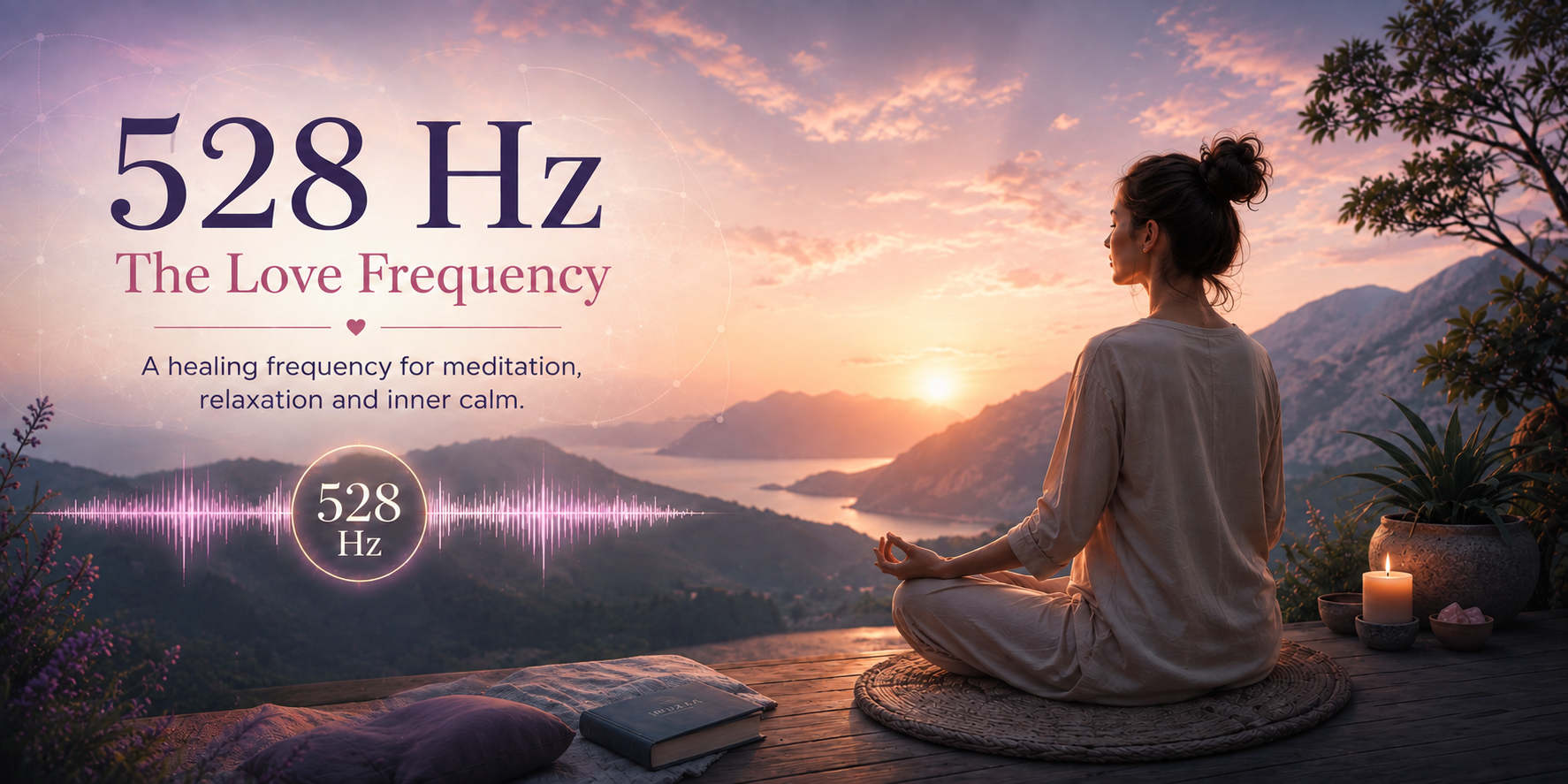
528 Hz has become one of the most recognized frequencies in the world of meditation, sound healing and mindful listening. Often called the "Love Frequency", it has developed a distinctive place in modern wellness culture.
At its simplest, 528 Hz is a tone vibrating at 528 cycles per second. But for many people, the experience is about more than a number.
A steady tone can create a quiet space in which the outside world feels a little further away. It can become an anchor for breathing, meditation, reflection or simply a few uninterrupted minutes with yourself.
That is where the Imuzar approach begins.
You do not need to believe that a frequency has magical powers to explore what it feels like to listen to one.
You simply need to listen.
What is 528 Hz?
There are sounds we hear, and there are sounds we choose to spend time with.
528 Hz has become one of the most recognized frequencies in the world of meditation, sound healing and mindful listening. Often called the "Love Frequency", it has developed a distinctive place in modern wellness culture.
At its simplest, 528 Hz is a tone vibrating at 528 cycles per second. But for many people, the experience is about more than a number.
A steady tone can create a quiet space in which the outside world feels a little further away. It can become an anchor for breathing, meditation, reflection or simply a few uninterrupted minutes with yourself.
That is where the Imuzar approach begins.
You do not need to believe that a frequency has magical powers to explore what it feels like to listen to one.
You simply need to listen.
Why is it called the Love Frequency?
The name "Love Frequency" comes from the modern Solfeggio frequency tradition and the spiritual and wellness communities that have grown around it.
Within those communities, 528 Hz has been associated with love, transformation, harmony and emotional renewal.
Some traditions go further, describing 528 Hz as a "miracle tone" or attributing powerful biological effects to it.
Those descriptions are part of the cultural story surrounding the frequency, rather than established medical facts.
But a cultural tradition does not have to be a medical claim to become meaningful.
For many listeners, the idea of using a particular sound as a symbol for love, calm and renewal can itself become part of a personal ritual.
You might listen to 528 Hz when you want to slow down.
You might use it while breathing.
You might play it during meditation.
Or you might simply enjoy the sound.
There is no single correct way to experience it.
What makes 528 Hz interesting?
Research into 528 Hz specifically is still relatively limited, but some early experimental studies are interesting.
A 2018 study compared music tuned to 528 Hz with music tuned to 440 Hz in a small group of healthy participants. The researchers measured several biological and psychological markers, including salivary cortisol and mood. They reported reductions in cortisol and tension-related measures following the 528 Hz listening condition. Because the study involved only nine participants, however, its findings should be regarded as preliminary rather than definitive proof of a unique healing effect.1
More recent research has also begun examining 528 Hz in controlled settings. A 2024 study involving 48 participants reported a reduction in state anxiety after a short exposure to 528 Hz music compared with a control condition. Again, this is promising but early evidence, and larger studies are needed to understand how reliable and generalizable the effect is.2
This is an important distinction.
We do not need to claim that 528 Hz can cure an illness to appreciate that researchers are interested in how particular musical frequencies may influence human experience.
And the broader research on music is encouraging. Large reviews have found that music interventions can influence physiological and psychological stress-related outcomes, although effects vary between studies and depend on factors such as the music itself, the listener and the context.3
In other words, the experience matters.
How 528 Hz can become part of your practice
Think of 528 Hz as an invitation rather than a prescription.
You can use it as an auditory anchor during a few quiet minutes of the day.
Find a comfortable place.
Put your device at a gentle listening level.
Close your eyes if that feels comfortable, or simply soften your gaze.
Then let the sound become the center of your attention.
Notice its character.
Notice your breathing.
Notice the space between one thought and the next.
When your attention wanders, gently return to the sound.
There is nothing to achieve.
You are simply creating a small period in which you are not required to respond to anything.
This is one reason sound can work so naturally alongside mindfulness. Meditation practices often use a sensation, sound, breath or other object of attention as an anchor for present-moment awareness.5
Creating your 528 Hz ritual
A ritual does not have to be complicated.
Try five to ten minutes at first.
You could listen:
- In the morning. Use 528 Hz as a quiet transition between waking up and beginning the day.
- During meditation. Let the tone give your attention a stable place to return whenever your thoughts wander.
- After a stressful moment. Give yourself a few minutes away from notifications, conversations and screens.
- During an evening wind-down. Lower the lights, put your phone aside and allow the sound to become part of a slower evening rhythm.
- During journaling. Play the frequency quietly while writing down thoughts, intentions or things you are grateful for.
The goal is not to listen for a predetermined amount of time or to force yourself into a particular state.
The goal is consistency.
A short practice that you genuinely enjoy is easier to return to than a complicated ritual that becomes another task on your list.
A frequency for intention
One reason 528 Hz has become so popular is that people have given it meaning.
The frequency has become associated with love, openness, transformation and emotional renewal.
You can use that symbolism in your own practice.
Before pressing play, choose a simple intention.
Perhaps:
- I want to slow down.
- I want to breathe more deeply.
- I want to release the day.
- I want to make space for myself.
- I want to approach the next hour with more calm.
The sound becomes a reminder of that intention.
And over time, hearing the same tone may become associated with the ritual you have created around it.
What might you experience?
There is no universal response to 528 Hz.
Some people describe steady tones as calming or grounding.
Others may find them useful for concentration or meditation.
Some may simply enjoy the sound.
And some people may not particularly enjoy it at all.
That is completely fine.
Sound is deeply personal. Musical preference, memories, environment, volume and expectations can all influence how listening feels.
You do not have to force a particular experience.
The point of mindful listening is to notice what is happening rather than deciding beforehand what you are supposed to feel.
A note on the science
Interest in 528 Hz is growing, but the scientific evidence specifically concerning this frequency remains limited.
Early studies are interesting and provide reasons for further research, but they do not establish 528 Hz as a medical treatment or prove that it can repair DNA, cure disease or produce the same effect in everyone.
The broader evidence around mindfulness, meditation and music-based practices provides stronger support for using these activities as part of relaxation, stress management and general well-being.5
That distinction does not make the experience less meaningful.
It simply gives us a more honest way to approach it.
Explore the sound. Notice your experience. Keep what works for you.
Try 528 Hz with Imuzar
Your practice does not need to begin with an hour of meditation. Start with a few quiet minutes. Choose 528 Hz. Put your headphones on, or let the sound fill a quiet room. Breathe. Listen. And allow yourself to be somewhere that does not require anything from you.
Explore 528 Hz in Imuzar and create your own listening ritual.
Key takeaways
- 528 Hz is a sound frequency widely used in modern meditation and sound-healing communities.
- It is commonly known as the "Love Frequency."
- Early research specifically examining 528 Hz has produced interesting findings related to anxiety, stress and physiological markers, but the evidence is still preliminary.
- Broader research supports the use of music and mindfulness practices as tools that may contribute to relaxation and stress management.
- You do not need to treat 528 Hz as a medical therapy to make it part of a meaningful meditation practice.
- The most useful frequency is ultimately one that you enjoy listening to and can incorporate consistently into your life.
References
Imuzar articles are based on peer-reviewed scientific research and trusted academic sources whenever applicable.
- Akimoto K, Hu A, Yamaguchi T, Kobayashi H. Effect of 528 Hz Music on the Endocrine System and Autonomic Nervous System. Health (2018). https://doi.org/10.4236/health.2018.109088
- Mehra H, Yeshaswini V. 528Hz: The Sound Of Tranquillity And Its Effect On Anxiety. Revista Electronica de Veterinaria (2024). https://doi.org/10.69980/redvet.v25i1S.787
- de Witte M, Spruit A, van Hooren S, Moonen X, Stams GJ. Effects of music interventions on stress-related outcomes: A systematic review and two meta-analyses. Health Psychology Review (2020). https://pubmed.ncbi.nlm.nih.gov/31167611/
- Adiasto K, Beckers DGJ, van Hooff MLM, Roelofs K, Geurts SAE. Music listening and stress recovery in healthy individuals: A systematic review with meta-analysis of experimental studies. PLOS ONE (2022). https://pubmed.ncbi.nlm.nih.gov/35714120/
- National Center for Complementary and Integrative Health. Meditation and Mindfulness: Effectiveness and Safety. https://www.nccih.nih.gov/health/meditation-and-mindfulness-effectiveness-and-safety
Frequently asked questions
Is 528 Hz really the Love Frequency?
"Love Frequency" is a popular name associated with 528 Hz in modern sound-healing and wellness communities. It is a cultural and spiritual description rather than a scientific classification.
Many people nevertheless enjoy using the frequency as a symbol of calm, love and emotional renewal.
What is 528 Hz used for?
People commonly use 528 Hz for meditation, mindful listening, relaxation, journaling, quiet reflection and evening wind-down routines.
Its value can come from the listening ritual itself as much as from the specific tone.
Can 528 Hz help with stress?
There is preliminary research suggesting that 528 Hz music may influence measures associated with stress and anxiety, but the evidence is still limited.
More broadly, research into music and mindfulness provides evidence that these practices can be useful components of relaxation and stress-management routines.
How long should I listen to 528 Hz?
There is no scientifically established perfect duration.
Start with around five to ten minutes and see how it feels. If you enjoy the practice, you can gradually make it part of your regular routine.
Consistency is more important than forcing yourself to listen for a specific number of minutes.
Should I use headphones?
You can use headphones or speakers.
Headphones can make it easier to create a private listening environment, while speakers may be preferable when you want the sound to remain part of the room.
Keep the volume comfortable.
Can I listen to 528 Hz before sleep?
You can incorporate calming sound into an evening wind-down routine if you find it relaxing.
The important factor is that the listening experience helps you transition toward a quieter environment rather than becoming stimulating or distracting.
Can 528 Hz repair DNA?
There is not enough evidence to make that claim.
Some online sources describe 528 Hz as a "DNA repair frequency", but this should not be presented as an established medical fact.
The research specifically studying 528 Hz is still early and does not establish DNA repair in humans.
Is 528 Hz better than 432 Hz?
There is no established scientific answer that one is universally better.
Both frequencies have enthusiastic audiences, and individual responses to sound can vary.
The best approach is to explore both and notice which listening experience works better for your own meditation or relaxation practice.
Is 528 Hz safe?
Listening to a tone at a comfortable volume is generally a low-risk listening activity for healthy people.
Avoid excessive volume, particularly when using headphones.
If a sound causes discomfort, anxiety, headache or other unpleasant symptoms, stop listening or reduce the volume.
Sound or meditation should not be used as a substitute for professional medical care when you have a health condition.